CH·BINAURAL · two ears, two drives
BINAURAL
One tone in the left ear. A slightly different tone in the right. The brain hears a third thing, a slow beat that is in neither headphone. Tune it below. Then read the 2,500-year argument over which sounds make people better, and which make them worse.
Headphones. Through speakers the two tones mix in the air and you hear an ordinary beat instead. Start low. The desk stops itself after 15 minutes. Not while driving.
The band names (delta, theta, alpha, beta) are EEG labels for brainwave speeds. Pressing one does not put your brain there. Source: Ingendoh, Posny & Heine, PLOS ONE, 2023.
Does it tune the brain? The record so far
5 support it8 contradict it1 mixed
A 2023 systematic review read every EEG study it could find on whether binaural beats pull brainwaves to the beat's speed. Fourteen qualified. Five said yes, eight said no, one was mixed. The authors concluded the question "cannot be settled at this point," and that the studies were built too differently to compare. The beat is real. The claim that it retunes you is not yet on the record.
Source: PLOS ONE systematic review, May 2023. A separate 2023 meta-analysis on memory and attention also found conflicting results: Psychological Research.
Sound shaped into proportion
The strings
Greek tradition credits Pythagoras with the discovery that the intervals that sound "right" are simple ratios of string length. Halve a string and you get the octave. Two-thirds gives the fifth. Three-quarters gives the fourth. Tap a string to hear it against the full length.
The last one is the equal-tempered tritone, the interval with no simple ratio, here so you can hear the difference. The ratio story comes to us from later writers, not from Pythagoras himself: Stanford Encyclopedia of Philosophy.
Two drives, on the record
The argument, 2,500 years long
Twenty-one stops. Blue rings: the case for order. Orange rings: the fear of frenzy. Gold: the science, and the figures who hold both.
-
ANTIQUITY
Apollo and the lyre
Apollo, god of music and order, plays the lyre: strings, tuned to fixed intervals, played with the hands while the mouth stays free to sing words. To the Greeks this made it the instrument of measure and reason.
The statue is a Roman copy in the Vatican's Pio-Clementino Museum.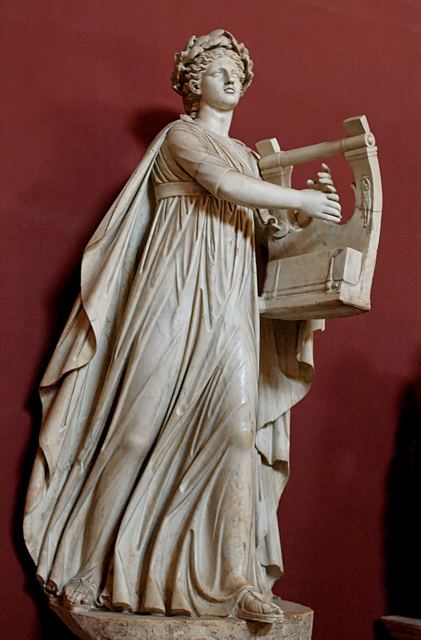
Apollo Musagetes, Vatican Museums -
ANTIQUITY
Marsyas and the pipe
The aulos is a double reed pipe, the instrument of Dionysian rites. In the myth, the satyr Marsyas challenged Apollo to a contest, pipe against lyre, with the winner to do as he pleased with the loser. Apollo won and flayed Marsyas alive.
Later writers read the contest as Apollonian against Dionysian. The myth itself just records who held the judges.
Source: Marsyas.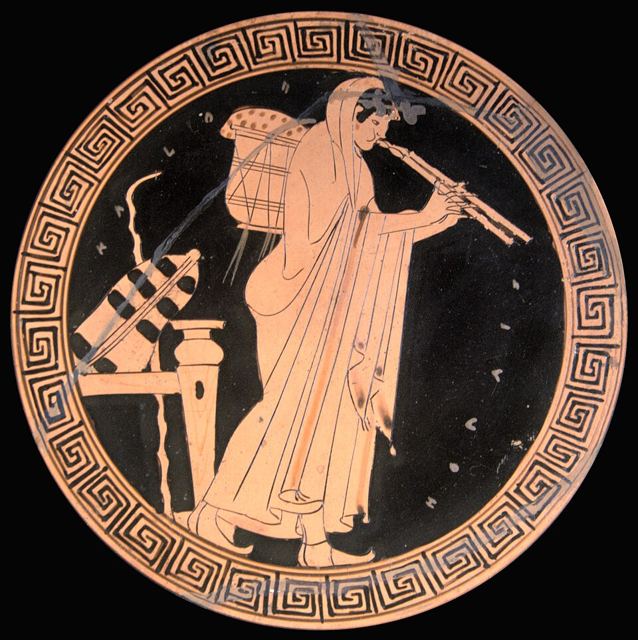
Aulos player. Cup by the Brygos Painter, c. 480 BC, Louvre G313 -
ANTIQUITY
Orpheus
In the myths, the poet Orpheus played so well that animals followed him and stones and trees moved. He took the lyre into the underworld to bring back his wife, Eurydice, was allowed to lead her out on one condition, broke it by looking back, and lost her.
He is the figure for music that crosses boundaries. The story ends badly.
Source: Orpheus.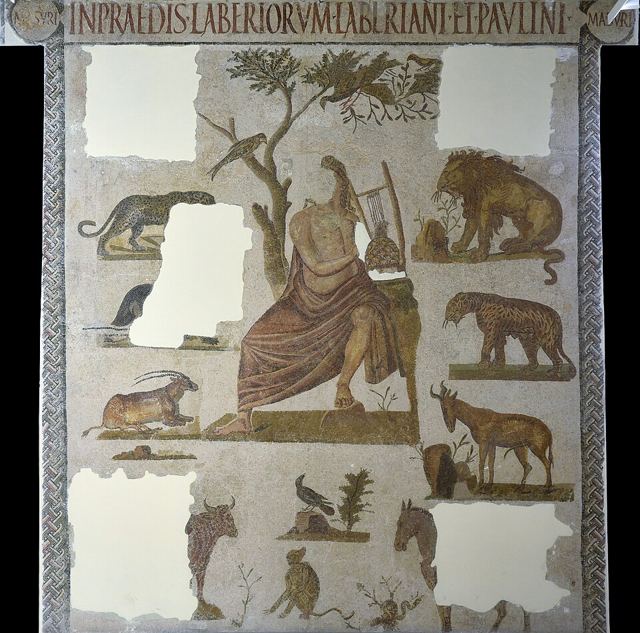
Orpheus taming the animals. Roman mosaic, 2nd–3rd c. AD, Bardo Museum, Tunisia -
c. 375 BC
Plato bans the soft modes
The Greek modes (harmoniai) were scales with names and, the Greeks believed, characters. In the Republic, Plato keeps the Dorian and Phrygian modes for the citizens of his ideal state and throws out the Lydian, Mixolydian and Ionian as soft or mournful. He goes further: change the music, and you change the laws of the state.
This is ethos theory, the belief that music shapes character, and therefore that music is a public matter.
Sources: Plato, Republic III, 398c–403c; on music and the laws, Republic IV, 424c. -
c. 330 BC
Aristotle hears the frenzy
Aristotle agrees that the modes shape character. The Dorian alone produces moderation and steadiness. The Phrygian stirs people into religious frenzy. So the young should be educated in music, and carefully.
Source: Aristotle, Politics VIII, 1340a–b. -
c. 520 AD
Boethius files music in three drawers
In De institutione musica, the Roman philosopher Boethius splits music into three kinds: musica mundana, the unheard harmony of the cosmos; musica humana, the harmony of body and soul; and musica instrumentalis, the music you can actually hear.
The book carried Greek music theory into the medieval classroom, where it stayed for about a thousand years.
Source: Boethius.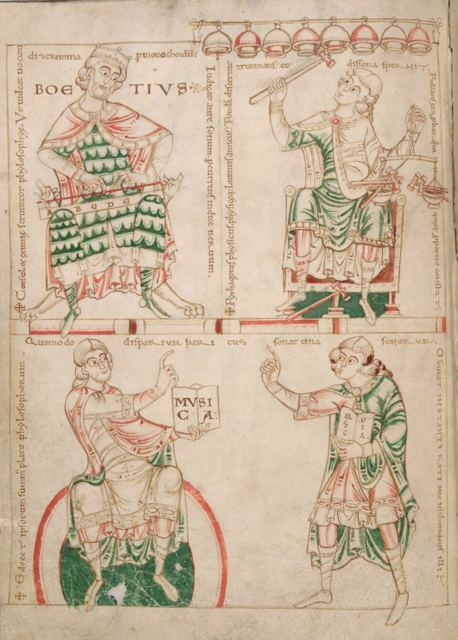
Boethius, Pythagoras, Plato and Nicomachus. Manuscript, c. 1130, Cambridge University Library Ii.3.12 -
1492
Pythagoras at the bells
Franchinus Gaffurius, music master of Milan Cathedral, prints Theorica musicae. Its woodcut shows Pythagoras striking bells, glasses, strings and pipes marked 4, 6, 8, 9, 12 and 16, the numbers behind the octave, fifth and fourth.
The picture is an emblem, not a lab report. Bells and hammers do not follow those ratios. Strings do.
Source: Franchinus Gaffurius.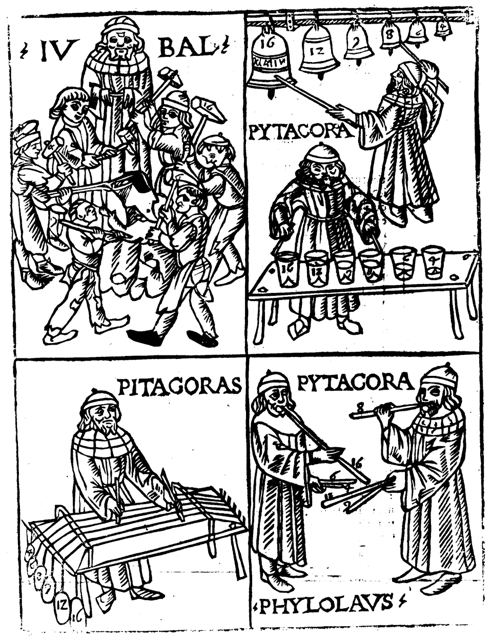
Woodcut from Gaffurius, Theorica musicae, Milan, 1492 -
1619
Kepler tunes the planets
Johannes Kepler publishes Harmonices Mundi, The Harmony of the World. He argues that the speeds of the six known planets form musical intervals, a literal music of the spheres.
The planets do not sing. But in Book V, chasing those harmonies, Kepler states his third law of planetary motion, which still holds.
Source: Harmonices Mundi.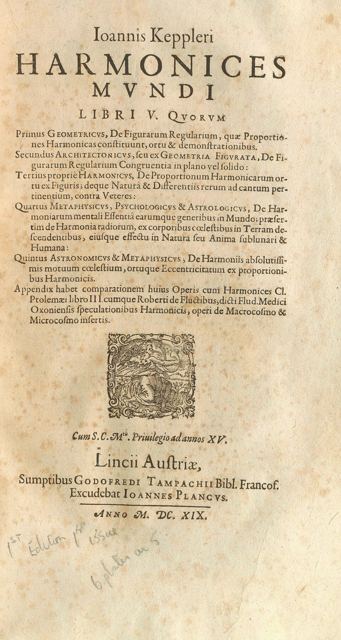
Title page, Harmonices Mundi, Linz, 1619 -
1702 – 1725
The devil in music
The tritone, the interval at the end of the strings above, was avoided in medieval church singing because it clashes. The nickname diabolus in musica, the devil in music, first shows up in print in 1702, from Andreas Werckmeister. Johann Joseph Fux's textbook Gradus ad Parnassum repeated it in 1725.
Myth check: no Church decree banning the tritone has ever been found. The devil came centuries after the avoiding.
Sources: Tritone; Skeptical Inquirer.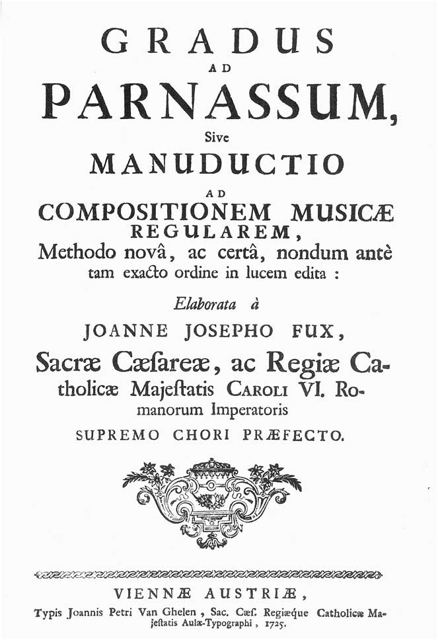
Title page, Gradus ad Parnassum, Vienna, 1725 -
1839
Dove finds the third tone
The Prussian physicist Heinrich Wilhelm Dove describes it: two slightly different tones, one to each ear, and the listener hears a slow beat at the difference. The beat is not in the air. It is made in the head.
Source: PLOS ONE, 2023.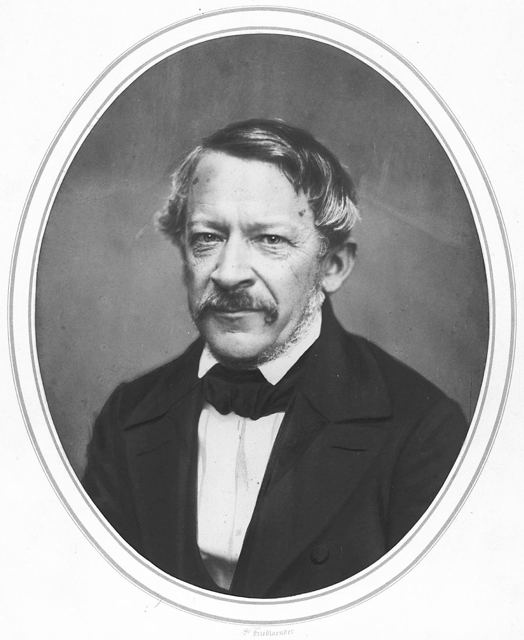
Heinrich Wilhelm Dove, 1857 -
1872
Nietzsche names the two drives
In The Birth of Tragedy out of the Spirit of Music, Friedrich Nietzsche gives the split its modern names. The Apollonian is form, order, the dream-image, sculpture. The Dionysian is intoxication, the dissolving of the self, and above all music.
He does not rank them. Greek tragedy worked, he argued, because it fused both.
Source: The Birth of Tragedy.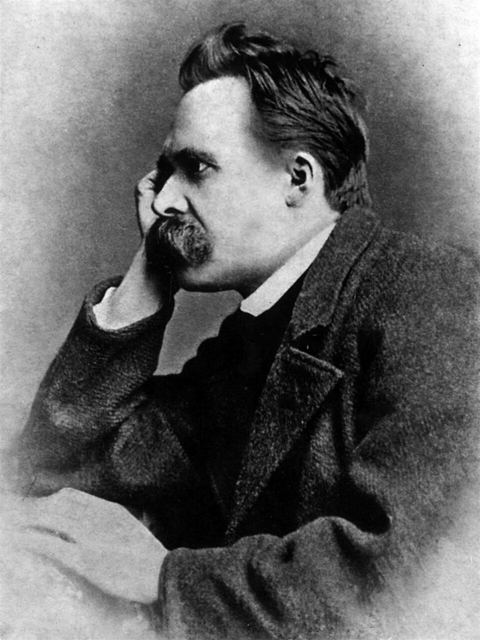
Friedrich Nietzsche, 1882. Photo: Gustav Schultze -
MAY 29, 1913
The Rite of Spring
Stravinsky's ballet premieres at the Théâtre des Champs-Élysées in Paris, with Nijinsky's choreography and Roerich's costumes. Rival camps in the audience shout over the orchestra. The conductor, Pierre Monteux, later recalled that "everything available was tossed in our direction."
The "riot" is often inflated. The performance finished, with curtain calls, and much of the anger was at the dancing, not the music. The ballet ran five more nights.
Sources: The Rite of Spring; San Francisco Conservatory.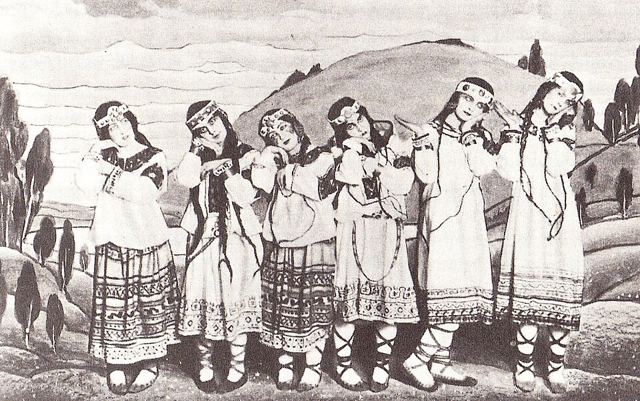
Dancers of the original production in Roerich's costumes, 1913 -
AUGUST 1921
Does jazz put the sin in syncopation?
Anne Shaw Faulkner, head of the music department of the General Federation of Women's Clubs, asks the question in the Ladies' Home Journal. Her answer: "Such music has become an influence for evil."
Same argument as Plato's, new mode. The music being blamed was Black American music.
Source: the article, transcribed.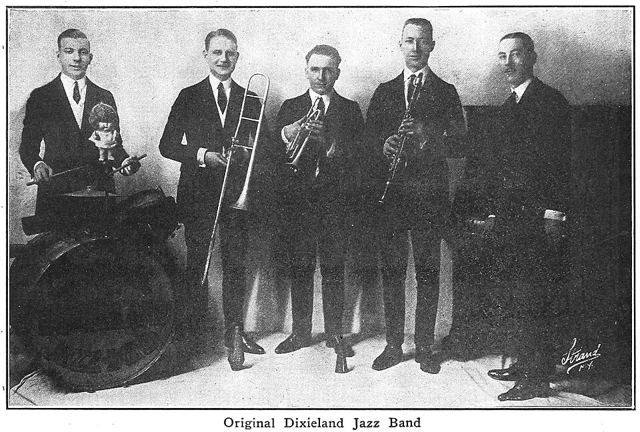
Original Dixieland Jazz Band. Talking Machine World, January 15, 1921 -
JANUARY 28, 1936
Muddle instead of music
Two days after Stalin sees Shostakovich's opera Lady Macbeth of the Mtsensk District at the Bolshoi, Pravda runs an unsigned editorial calling it "muddle instead of music": formalist, coarse, vulgar. The opera is pulled from Soviet stages.
The state did not ban a sound. It named one, and everyone understood.
Source: Muddle Instead of Music.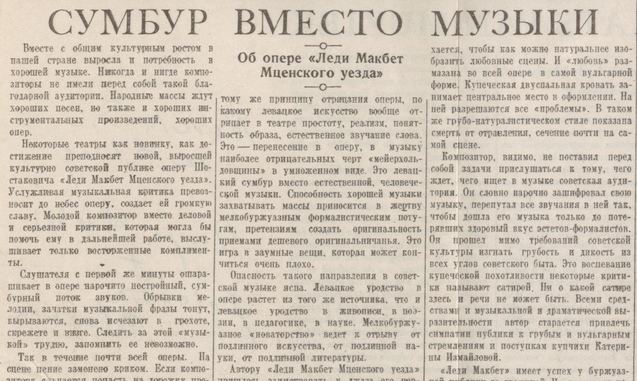
Pravda, January 28, 1936 -
MAY 1938
Degenerate Music
At the Reich Music Days in Düsseldorf, the Nazi official Hans Severus Ziegler opens Entartete Musik, an exhibition against jazz, atonal music and Jewish composers. Visitors could step into booths and listen to the music they were being taught to hate.
The poster is the argument: a racist caricature of a Black saxophonist wearing a Star of David. Race, religion and a musical style, drawn as one threat.
Source: German History in Documents and Images.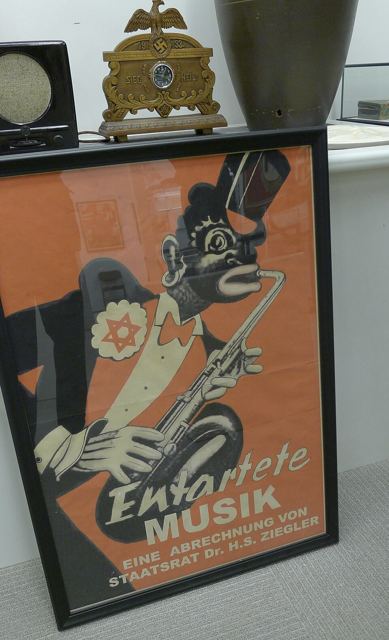
Exhibition guide, 1938, at the Museum of World War II, Natick. Photo: leewrightonflickr, CC BY 2.0 -
1956
The jukebox purge
Asa Carter, head of the North Alabama Citizens' Council, said the NAACP had "infiltrated" Southern white teenagers with "immoral" rock and roll records. He called on jukebox owners to remove every record by Black performers.
The music was called corrupting. The objection was to who made it.
Source: Asa Earl Carter.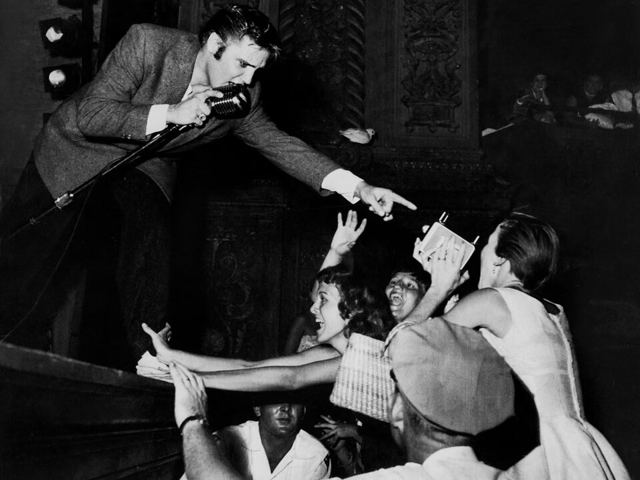
Elvis Presley at the Olympia Theater, Miami, August 3, 1956. Photo: Don Wright, Miami Herald -
1973
Oster brings the beat to the lab
Gerald Oster's article "Auditory Beats in the Brain" in Scientific American gathers 130 years of scattered findings on Dove's effect and makes binaural beats a research subject. Fifty years of studies follow. See the record above for where they stand.
Source: PLOS ONE, 2023. -
JULY 12, 1979
Disco Demolition Night
At Comiskey Park in Chicago, fans who bring a disco record get in for 98 cents. Between games of a doubleheader, a radio DJ blows up a crate of the records in center field. Thousands of fans rush the field, and the White Sox forfeit the second game.
Critics then and since have read the night as aimed at disco's Black, Latino and gay audiences. The records said nothing; the crowd said plenty.
Source: Disco Demolition Night.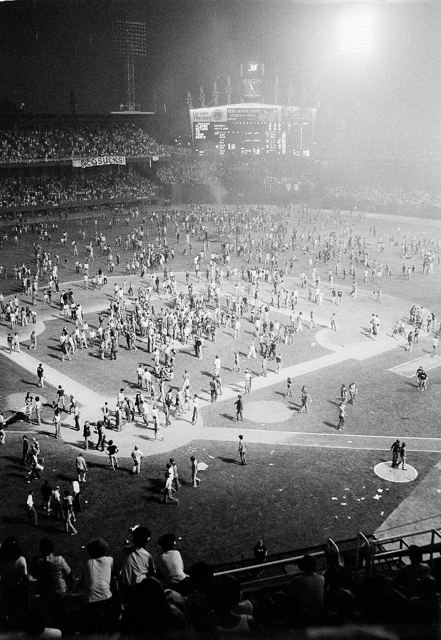
Comiskey Park, July 12, 1979. Photo: Fred Jewell -
SEPT 19, 1985
The Senate hears rock
The Parents Music Resource Center, led by Tipper Gore and Susan Baker, brings its "Filthy Fifteen" list, songs it tagged for sex, violence, drugs or the occult, to the Senate Commerce Committee. Frank Zappa, Dee Snider and John Denver testify against labeling. On November 1, 1985, the RIAA agrees to put warning labels on selected releases.
Source: Parents Music Resource Center. -
1990 – 1992
A rap album declared obscene
A federal judge in South Florida rules 2 Live Crew's As Nasty as They Wanna Be legally obscene. In June 1990 Broward County deputies arrest three members of the group after a show. In 1992 the Eleventh Circuit overturns the obscenity ruling.
Source: As Nasty as They Wanna Be. -
MAY 25, 1993
A patent on the beat
Robert Monroe, whose institute sold "Hemi-Sync" tapes, is granted US patent 5,213,562 for a method of inducing states of consciousness by sending each ear a different carrier tone so the difference makes a beat: Dove's effect, as a product.
A patent records that an invention is new. It does not record that it works. For that, see the 5–8–1 count at the top of this page.
Source: US 5,213,562.
Mechanism, not motive
The pattern
- A new sound arrives, often from people outside power.
- It is called discord: noise, frenzy, the wrong mode.
- Authorities say it corrupts the young and the order.
- A generation later it is the mainstream, and the next sound is the threat.
The honest frame. "Harmony" and "dis-harmony" here are philosophy, not acoustics. No study has shown a scale or a genre to be moral or immoral. The record shows something else: each time, the fight over the music was also a fight over race, age and who gets to speak.
Pictures
All from Wikimedia Commons. Public domain unless noted: Apollo Musagetes · Aulos player, Louvre G313 · Orpheus mosaic, photo by Carole Raddato, CC BY-SA 2.0 · H. W. Dove · Nietzsche · Elvis Presley, 1956 · Boethius manuscript · Gaffurius woodcut · Harmonices Mundi · Gradus ad Parnassum · Rite of Spring dancers · Original Dixieland Jazz Band · Pravda, 1936 · Entartete Musik guide, photo by leewrightonflickr, CC BY 2.0 · Disco Demolition Night. Images resized.